Ministry of Social Affairs
Handling the UndeadThe Ministry of Social Affairs is one of the institutions called upon to manage the public consequences of the dead returning to life. Its role combines emergency policy, planning for the relocation of the reliving, and classified documentation of an investigation. The crisis exposes the tension between rapid administrative action and incomplete knowledge: officials impose new rules and seek a workable arrangement, even as hospitals struggle and the ministry cannot yet disclose what that arrangement will be.
Institutional role and emergency setting
The unfolding crisis is first presented as a sequence of reports rather than as the work of a single agency. As calls about returned relatives overwhelm the emergency call centre, paramedics, counsellors, and religious ministers are gathered and assigned to affected families. Danderyd Hospital is designated as a temporary gathering place, while the mounting number of arrivals strains the staff. These early details establish the scale of the public emergency in which government departments must respond; they do not, by themselves, attribute every measure to the Ministry of Social Affairs.
At 00.22, the Minister of Health and Social Affairs arrives at the department, and a provisional command unit is formed under the minister’s supervision. It includes representatives of several departments and the Police, alongside prominent physicians from different disciplines. A conference room becomes a temporary command centre, soon known as the Dead Room. This is the institutional setting for the first hours of crisis management. The account identifies the minister and the participating bodies but does not equate this command structure with the later, specifically named Ministry of Social Affairs; the distinction matters when tracing which decisions the text attributes to which office.
The emergency setting also reveals limits to coordination. By 01.45, Danderyd is losing control, with 715 reliving admitted and disputes, including fistfights, breaking out among staff in direct contact with them. Five minutes later, the military calls in Army Corps members to erect a temporary holding facility without consulting the Dead Room. The episode shows that the command centre operates amid competing institutional responses rather than exercising uncontested control. The immediate problem is no longer only how to receive the returned dead, but how to contain and organize a population that the existing hospital arrangements cannot accommodate.
Public policy and political pressure
The Ministry of Social Affairs is named directly in the announcement of a major policy decision. At a press conference, the Minister of Social Affairs says that the parliamentary meeting has decided to prohibit all burials and cremations for an indefinite period. The stated context is that four people who died in the Stockholm area during the night have shown no signs of awakening. The ban turns uncertainty about whether the dead may return into a change to ordinary funeral practice: bodies must remain available, and the usual routes of burial and cremation are suspended.
The exchange also makes the logistical uncertainty plain. Asked whether there is enough space to store so many bodies, the minister says that there is enough for the moment, noting that the morgues have never been so empty. The reassurance is explicitly temporary. The policy is broad and open-ended, while the answer about capacity extends only to the immediate situation; the gap between those two time scales gives the decision its practical and political weight.
That pressure appears in press coverage of the government’s handling of the crisis. Conservative parties unite in a declaration of no confidence, described as exceptional so close to an election. The leader of the Moderates criticizes the government’s handling as clumsy and argues that relatives should be allowed to see their reliving. The Ministry of Social Affairs is not identified as the sole author of the government’s wider response, but its public policy sits within this dispute over containment, access, and the rights of families. The controversy makes clear that administrative caution is not politically neutral: restrictions intended to manage an unprecedented situation also shape whether families can approach their returned relatives.
Relocation, research, and the limits of knowledge
Karin Pihl, identified as an expert at the Ministry of Social Affairs, describes the existing situation as untenable in a reporter’s interview about plans to relocate the reliving. She says that work on a temporary solution has been underway since the previous day, but that she cannot provide further details. Her answer establishes both an active planning effort and a limit on public information. Relocation is presented as a necessary response to the failure of keeping the reliving together in hospital, yet the solution remains undisclosed at the time of the interview.
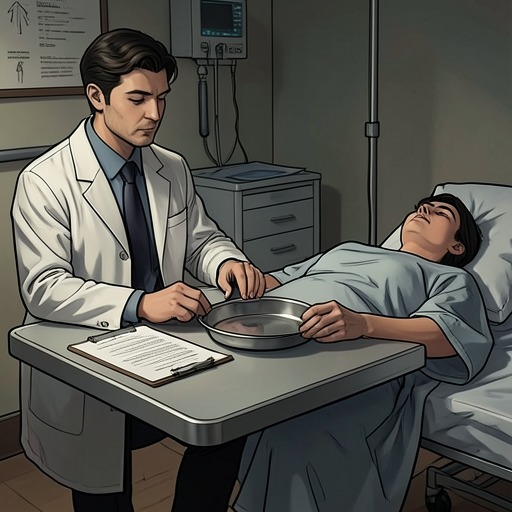
A classified Ministry of Social Affairs document supplies another view of its activity: a quick investigation labelled attempt five, concerning decomposition. The record gives a precise procedural detail for patient Greta Ramberg. On 15 August 2002 at 09.00, her temperature requirements were concluded; she had been isolated in her own room while the climate control was gradually adjusted to 19 degrees Celsius, described as normal room temperature. The document records the conditions and the completion time, but the cited material does not state a result about decomposition. Its administrative precision therefore coexists with unresolved scientific questions: a measured temperature and a completed procedure do not, on their own, explain what is happening to the reliving.
Later, all staff have left Danderyd Hospital and military vehicles have gathered outside its entrances. The report says that there is no information yet about what is happening, and notes that the Prime Minister has scheduled a press conference for the next morning. This snapshot does not establish that the Ministry of Social Affairs ordered the departure or controls the military presence. Instead, it closes the ministry’s documented arc within an atmosphere of incomplete explanation: officials have made a sweeping rule, described relocation as necessary, and recorded a controlled investigation, while the wider emergency continues to exceed what the available announcements can clarify.